
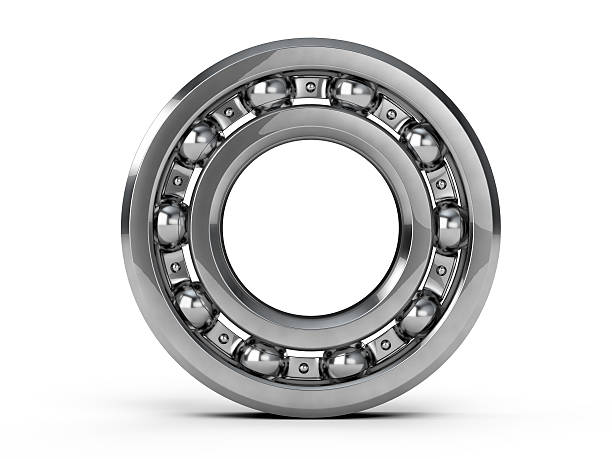
Angular contact ball bearings feature significantly in several mechanical applications because of their characteristic feasibility to accommodate bidirectional forces. Due to their design and construction, they can be used in high speed applications and where accuracy and dependability is important. This article aims to describe in detail about angular contact ball bearings its construction, application and its advantages.
What Are Angular Contact Ball Bearings?
Angular contact ball bearing is designed for carrying radial as well as thrust load. Compared with the radial ball bearings in which balls are only subjected to the radial force, angular contact ball bearings are capable of carrying the force acting along the axis of the shaft. This is made possible by their inner and outer ring raceways which are oriented at a specified angle with regards to the bearing axis. This angular contact makes it possible for the bearing to have high axial load in one direction as compared to the other thus enhancing stability and efficiency.
Key Features and Construction
Design and Geometry
These bearings have an inner and outer ring together with a ball and cage assembly in the approach to categorize the angular contact ball bearings based on the contact angle which varies from 15° to 40°. This angle defines the maximum loading capacity of the bearing for Axial loads. It was established that the higher the contact angle, the bigger the axial load capability of the plate. The bearings are comprised of an Internal Ring, an Outer Ring, a Retainer and Balls disposed either in one or more rows.
Contact Angle
Contact angle is the angle between the directions of the resultant force, which is load its self, and a line drawn perpendicular to the bearing axis. It has impact on the load control and on how the bearing behaves. The bearings with a higher contact angle are better in a way that they can tolerate higher Axial load as compared to radial load.
Types of Angular Contact Ball Bearings
Single Row: Single Row Ball Bearings possess one row of balls and can accommodate axial loads in one direction only. Being versatile devices, they find frequent applications in designs that are compact and necessitate rapid operations.
Double Row: Double row angular contact ball bearings consists, of two rows of balls which has ability to support the axial load in both sides. They have higher load ratings as compared to standard types, thus they are ideal in applications where a higher load is anticipated.
Four-Point Contact: These are bearings developed to support formations of loads along a specific direction as well being used with high precision and stiffness.
Applications
Angular contact ball bearings are used in a variety of industries and applications, including:
Aerospace: Since aerospace products and services involve safety and timeliness, precision and reliability are invaluable in aerospace. Angular contact ball bearings are utilized in aircraft engines, the landing gear systems and other harsh operating equipment.
Automotive: In automotive industry they are used in wheel hub, transmission system, and in steering system where high speed and load carrying capacity is required.
Machine Tools: These bearings are utilized in machine tools due to their high speed capability as well as their accuracy. These are used in spindles, gear boxes and others such high accurate machines.
Medical Devices: Angular contact ball bearings are critical for the medical industry due to the requirements of high degrees of accuracy and reliability in surgical tools, diagnostic equipment and other instruments utilized in the operation.
Benefits
High Load Capacity: contact ball bearings are intended for high load application and accept both radial and axial loads higher than those of radial bearings.
High-Speed Performance: They have low frictional resistance; this makes them to operate at high speed hence suitable for use with precision motion systems.
Durability: Thus, red color and clever positioning are not the only factors defining contact ball bearings: the bearings are rather built of noticeably more durable and qualitative materials and components.
Versatility: Various types of contact ball bearings are available, thus it is implemented in different applications to suit the needs of certain particular application.
Angular contact ball bearings are widely used in many high speed and high precision operation machinery. Due to the fact that they can bear both radial and axial loads their use is preferred where performance and durability are an important factor. This knowledge will assist one make the appropriate bearing for the job so as to make the parts work efficiently within the mechanical systems.
Apart from that if you want to know about “7 Common Myths About Self-Lubricating Bearings You Should Stop Believing” then please visit our “Strategy” Category.